Train in CS2: The Sites, Smokes, and Rotations People Misplay

Train looks simple until you’re the one calling the round and watching three people die to the same mistake. One late Ivy smoke, one lazy connector-to-B bomb, and suddenly the whole half feels cursed. That’s Train in CS2: not a map where you get styled on by some mystical geometry, just a map that punishes bad spacing, bad utility, and bad timing harder than most people want to admit.
And yeah, Source 2 made the map feel cleaner, but it didn’t make it kinder. Subtick gives your inputs that extra bit of snap, sure, yet Train still rewards the team that understands when to fight, when to fake, and when to stop donating rotations like it’s 2018 Faceit level 6.
Why Train still breaks people
Train has always been a map of lanes, sound cues, and ugly little timing traps. You don’t just “take map control” here the way some teams talk about Mirage mid like it’s a prayer. You’re either holding a narrow funnel, contesting a fast lane, or burning utility to make the other side move first. That’s the whole knife fight.
CTs love to overrotate on Train because the map makes every footstep sound like a full commit. One man hears pressure at Ivy, another sees a flash pop near inner, and suddenly the B anchor is sprinting through hell while A gets walked in on. T side players know this. Good T sides abuse it. Bad T sides still run into A main, die, and call it “bad timing.”
The sites aren’t symmetrical, and people play them like they are
A site: not just “hold main and pray”
A site is messy in a way that feels obvious after the round is over. You’ve got A main pressure, Ivy pressure, Popdog control, and the constant threat that someone’s just going to swing out of a smoke and ruin your crossfire. The common misplay is stacking too much attention on the obvious choke while ignoring the quiet one.
The real problem? Most teams defend A like they’re waiting for a highlight reel. They over-commit to the first contact, then get isolated by a simple smoke sequence. If T side gets Popdog and Ivy at the same time, your A anchors can’t just stand there and hope the post-plant doesn’t happen. That’s how you get those ugly 2v4 retakes where the CTs are stuck behind freight and the bomb’s already tucked on site.
On the attack, people also misread A. They throw the “standard” set, but they don’t actually pair it with a hit. A smoke without timing is just expensive theater. If your Ivy smoke lands and no one pressures it, CTs get free info. If Popdog is smoked but nobody scales with it, you’ve basically paid for a decorative wall.
B site: where half the server forgets the rotation exists
B on Train is where over-rotations become a religion. Inner pressure can feel terrifying from CT side, especially if you’ve seen teams like NAVI or Vitality punish slow reactions on big stages. But that fear is also why people throw rounds away. One fake at A, one molly in Popdog, and the CT anchor starts mentally packing his bags for B before the execute even lands.
The mistake on B is usually simple: players peek too early, get picked through utility, and then the site collapses because everyone else rotated off the bomb train. If you’re CT, your job isn’t to hero swing through smoke because you “felt the timing.” Your job is to stay alive long enough for the rotation to matter.
On T side, B hits are strongest when they’re fast and clean. Not sloppy. Fast and clean. There’s a difference, and pro teams make it look easy because they know exactly which smoke isolates the bomb train, which flash pops off the roofline, and when to stop sending extra bodies into the grinder.
The smokes people keep butchering
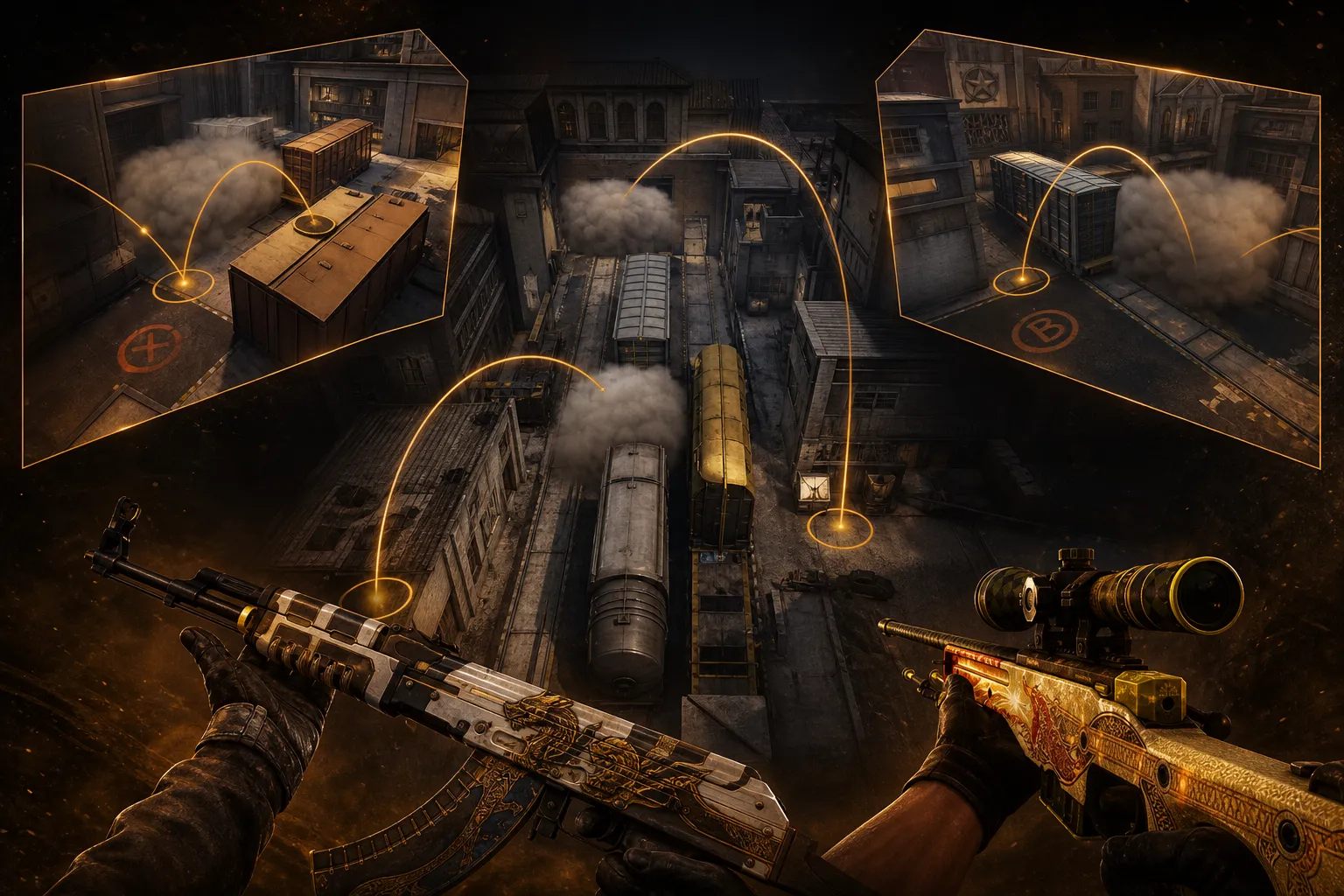
Train utility isn’t hard in theory. The hard part is that one bad throw on this map can open a lane for the CTs to punish for 20 straight seconds. If you’re learning Train, these are the smokes that actually matter:
- Ivy smoke. It’s not optional. If you don’t cut Ivy, CTs get vision and a rotation route for free.
- Outer/mid lane control smoke. Use it to deny the fast peek that turns your default into a bloodbath.
- Popdog cover. You need this if you’re planning to scale A without getting farmed from above.
- Inner molly. Not sexy, but it buys space and forces ugly CT movement.
- Connector-to-B lane smoke. This one saves lives more than aim does.
The bigger issue is that people toss utility like they’re playing 128-tick CS:GO and everything will magically line up. CS2’s subtick system changed the feel, but it didn’t change the fact that utility timing is still the real skill. A smoke that lands a second late on Train can completely change a round because one player has already crossed, one anchor has already rotated, and now your execute hits an empty site with a killfeed in the wrong color.
And no, you don’t need seven pieces of utility to make a basic T round work. Sometimes one smoke and one flash are enough if your spacing is decent and your players aren’t taking turns dry-peeking like it’s Premier at 12,000 rating.
Rotations: stop moving like you’re afraid of commitment
Train punishes panic rotations more than almost any map in the pool. The map is long, the sightlines are annoying, and the sound cues are so clear that every bad movement gets broadcast to the whole lobby. If you rotate too early, you hand over space. If you rotate too late, you’re saving a rifle and wondering what happened.
The CT side mistake is reading every piece of info as proof. One Ivy smoke doesn’t mean A is gone. One footstep at Popdog doesn’t mean B is fake. Good teams, the kind you see at Majors when pressure actually matters, make you prove the hit with utility and bodies, not vibes. That’s why donk’s aggression works when Spirit are sharp: they’re not just taking fights, they’re turning info into a decision before the other team can settle.
On T side, rotations are where the fake rounds live or die. A real fake on Train needs more than noise. It needs the threat of contact, the utility to back it up, and enough map control that the CTs believe their own panic. If your fake is just two footsteps and a smoke bloom, people at higher CS Rating are eating that for breakfast.
How good teams actually play the map
Watch m0NESY or ZywOo on a map like Train and the pattern is obvious: they’re not taking random hero duels. They’re using the map to create tiny advantages, then cashing them in before the round gets messy. One player pressures outer, another is ready to punish the rotation, and suddenly the entire defense is one bad guess away from collapse.
That’s why Train shows you who actually understands Counter-Strike and who just likes aim clips. Teams that win here usually do a few boring things very well:
- they hold for the second rotation, not the first;
- they keep a spare flash for the mid-round pivot;
- they don’t overchase a one-man advantage into a trade death;
- they’re fine spending 20 seconds on space before pressing the site hit;
- they know when to end the round with a save instead of a desperate retake.
The economy matters too. If your CT side is stuck on one M4 and a couple of half-buys, Train gets ugly fast because the lanes are so open once utility runs out. That’s why a disciplined 3,200-credit buy on T side or a tight 4,300-ish CT full buy matters here more than on looser maps. One bad force and you’re staring at a bonus round that disappears because nobody respected the spacing.
The real Train lesson nobody wants to hear
Train doesn’t reward “trying hard.” It rewards teams that understand pressure, lane control, and rotation discipline. The sites aren’t hard because the bombs are weird or the map is old-school. They’re hard because every mistake is visible, every rotate is loud, and every smoke mistake gives the enemy a free opinion about your setup.
If your Train games keep falling apart, don’t blame the map. Ask yourself the annoying question: are you actually taking space, or just making noise and hoping someone else blinks first?